
Silicon Photonics: How Can the Data Center Manager Benefit Now and the Future?

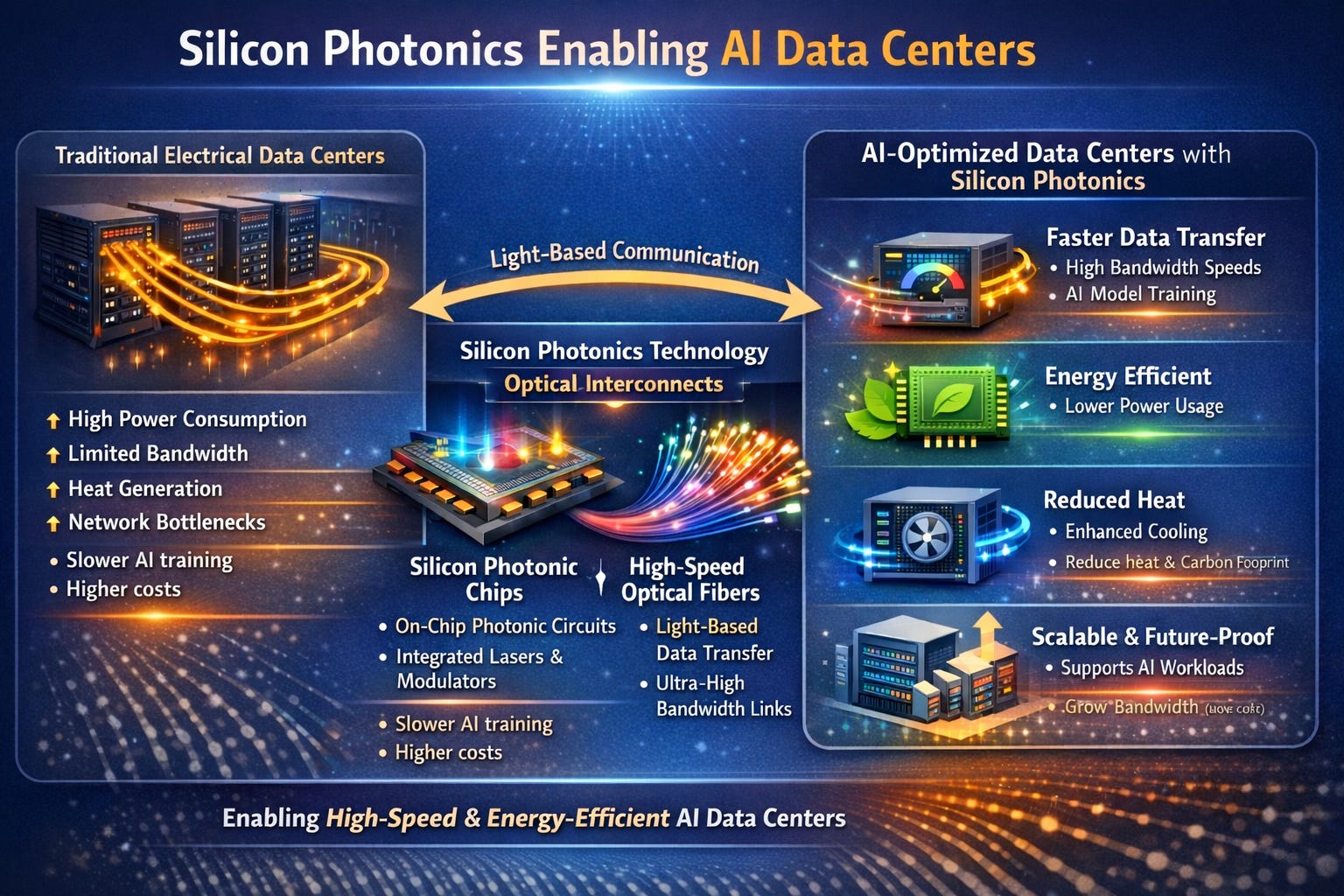
I thought of calling this CIR DeepTech: A Song of Ice and Fire, but decided against it. As everyone knows this is the time of year when meteorologists proclaim a weather apocalypse that never quite materializes. This is certainly true in my little city of Mechanicsville, Virginia. As I write, we are at about two inches of snow. I may have spoken too soon; more snow to come perhaps, and, in any case, there is some Data Center news being made out of this. However, I am devoting much of this issue on (1) why data center managers should think about deploying more silicon photonics, (2) the future of micro data centers and (3) why I still want to believe in the Metaverse.
Trump Taps into Data Center Power
Electricity providers, including data centers, are now told by Energy Secretary, Chris Wright that they will need to “tap, baby, tap” into available backup power when blackouts are threatened or even during peak demand periods and “national energy emergencies.” These measures are being taken under a law giving the energy secretary power to take control of electricity generating facilities to meet demand in emergency situations.
Nonetheless, this seems a strange time to make such things a matter for public policy debate, when it seems the hyperscalers can’t come up with electricity sufficient for their own needs and are making poorly thought out pleas on TV to the populace claiming that they are the good guys and may actually be reducing the cost of energy for the average Joe. This is a big deal right now with the Administration currently working with a bipartisan group of governors which in turn is call on the nation’s largest grid operator, PJM Interconnection, to make tech companies more adequately cover its energy costs
Spatial Computing in the Data Center: The Third Coming of Virtual Reality?
A Preamble: I have been something of a sucker for virtual reality (VR) ever since I wrote a report on the market potential for networked VR a few decades ago. The report didn’t do well. Then I attended a big VRfest at the Smithsonian when I lived in DC in the 1980s and then CES in the early 2000s where I went with the specific intention of seeing what VR had to offer at that time. Trying to be a good little analyst here; the answer seems to be not that much. The Smithsonian event was a bit boring and 15 years later my CES experience was not much better.
Recent news out of the VR “industry” (it is hardly an ‘‘industry”) shouldn’t have left me more sanguine. Layoffs and product wind-downs inside Reality Labs, is not encouraging at all, proving only that what the VR industry (the “I” word again”) Meanwhile, Microsoft retired “Mesh” (too close to the “Matrix?”) in its original form. Microsoft “Mesh” was a cloud-based platform for collaboration in “mixed reality” in a shared immersive space. In these apparently straightened times, what is left of Mesh seems to have been bundled with Microsoft Teams. Although I have also heard from several sources that the VR market is not dead, but rather “resetting,” this reminds me of the Monty Python famous “Dead Parrot” sketch where one of the characters asserts that the parrot-of-interest isn’t dead, but ‘just resting.”
If I was looking for something positive to say about VR, what I might easily come up with is that it is very good at changing names. Reality Labs, after all, used to be Oculus VR and is owned by Meta, which used to be Facebook. And VR is hardly ever called VR these days, but rather the “Metaverse” or the mystical-sounding “mixed reality.” The next iteration in VR nomenclature may well be “spatial computing”, which refers to computing systems that understand, simulate, and interact with the three-dimensional physical world in real time. It combines technologies such as computer vision, sensors and real-time rendering and AI/AR in next-generation data centers with new opportunities and challenges.
Even though my personal investments in both META and MSFT are down by about 4-5, I continue to believe, as the X-Files once had it. Psychedelics never worked for me, so perhaps I am hoping to find God through VR? Or not.
At CIR we think that spatial computing workloads impact data center architecture, operations, and long-term strategy. Spatial computing will be the body of future artificial worlds, subsuming AR/VR as the eyes and AI as the brain. At the same time, OpenXR, glTF, etc. are increasingly central to making “many worlds” work together. And the Metaverse Standards Forum focuses on coordinating requirements across many standards bodies (it doesn’t create standards itself). Governments have also gotten in on the act. The EU continues to frame “Web 4.0 and virtual worlds” as part of a broader technology transition, with policy objectives and standardization planning referenced in its rolling plan materials.
So anyway, for our paid subscribers only (to join us click on https://cirdeeptech.substack.com/subscribe), you will find out how spatial computing will transform the data center in the next few years. And this will be followed by the all the arguments fit to print for why progress for SiPho means progress for AI data centers. The evolution of SiPho will make it the key enabling technology for these data centers as they begin to scale up.
